Guitar Setup: The Essential Dimensions for a Perfect Setup
The curvature of the handle
The first thing to consider is the curvature of the neck. The ideal curvature depends on several factors, but as a general rule, a slight concavity (or relief) is necessary to allow the strings to vibrate without rubbing against the frets. To do this, using a credit card or business card (about 0.1 mm thick) makes it easy to measure this space at the 7th or 8th fret.
Too much curvature will result in too high an action, while too little curvature could cause buzzing. It is therefore crucial to adjust this curvature correctly to ensure good playing comfort.
The height of the strings
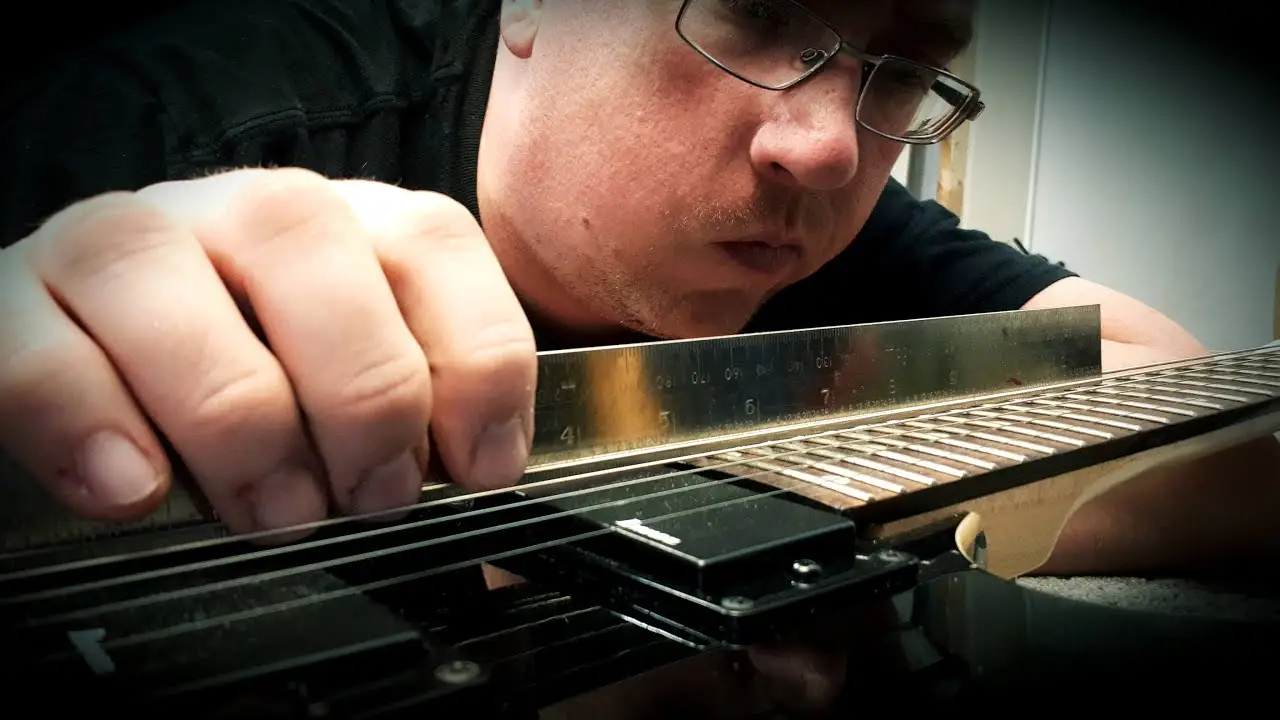
String height is also a determining factor for playing comfort. The ideal height varies depending on the playing style and the guitar, but there are some basic values. For example, the ideal string height at the 12th fret is approximately 1.6 mm to 2.4 mm for bass strings, and 1.2 mm to 1.6 mm for treble strings.
If the pitch is too high it can cause pain and difficulty playing, while too low a pitch can cause buzzing and poor intonation.
The angle of the easel
Another important factor is the bridge angle. The angle of the bridge affects the action of the strings and can influence the tone of the instrument. In general, too shallow an angle can cause sustain issues, while too steep an angle can make the instrument difficult to play. Therefore, adjusting this angle is essential for a good balance between comfort and performance.
The microphones and their distance from the strings
Finally, pickups play a crucial role in the sound of the guitar. The distance between the pickups and the strings should be adjusted depending on the type of pickup and playing style. A good rule of thumb is to keep the pickups about 1-2mm from the strings for single coil pickups and 2-4mm for humbuckers.
Improper adjustment of microphones can result in loss of power, sonic interference, or unwanted distortion.
If you encounter any issues or want to discuss your own settings, feel free to leave a comment or ask questions. Good luck with your adjustments!