You probably have a guitar that's been gathering dust in a closet for years. Maybe it was your first, a gift, or a find on Marketplace. It looks cool, but it doesn't play very well, and every time you think about it, you tell yourself: "It'll cost too much for what it's worth."«
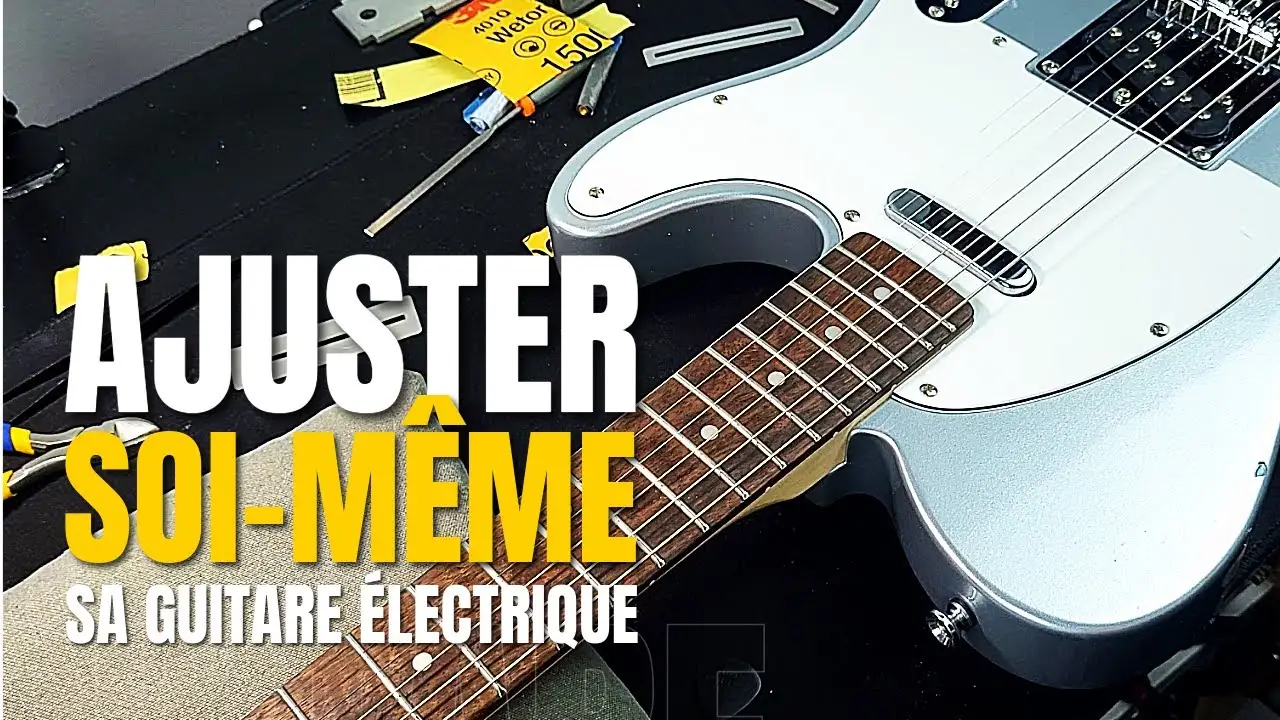
Today, we're changing all that! I have a small Squier Telecaster Affinity which belongs to a youth center. It needed some love, and I'm going to show you how to transform this forgotten instrument into a guitar that really makes you want to play, with a few simple adjustments.
1. Inspection and Initial Diagnosis
Visible Problems
- One rope was missing.
- One was missing bridge screw (saddle).
- A finished worn revealing earlier layers of paint (metallic gray, blue, then gold!) — interesting, but not essential to setup.
- The mechanics are functional, the output jack is tight.
- The electronics were quickly tested and are functional.


Crucial Playability Measures (Before Removing the Strings)
The three important measurements for playability are nut height (lower frets), neck curvature (relief), and string height (action).
- Height of the nut (First fret):
- I press down on the third fret and assess the space at the first. The space was satisfying (a little clearance was needed, but it was not excessive).
- Curve of the English Channel (Relief):
- In playing position, I fretted the string at the first fret and at the junction of the neck and body.
- The space halfway between these two points was huge (concave)! This indicated that the handle had far too much curvature without even being under tension, which causes high action and a difficult game.


2. Preparation and Correction of Defects
After removing the strings, I proceeded with the corrections.
Restoration of the bridge and buttons
- Bridge screw: I replaced the missing screw with a spare part (from Amazon or another guitar) which, fortunately, went in perfectly without forcing.
- Potentiometers: The potentiometers (pots), which have no fixing screws and are press-fitted, were pushed in too deep and they were scratching as they turned. I used a thin tool like a lever (with a protective cover on the body) to slightly lift the buttons and create a small space, making the game much smoother.


Neck Adjustment: The Truss Rod
The handle had too much concave curvature. The goal was to tighten the truss rod to straighten it and obtain a handle perfectly flat before applying the tension to the new strings.
- Flatness Check: I used a notched ruler (25.5″ side for Fender) to confirm the excessive bend without tension.
- Tightening: I inserted the correct size Allen key. The truss rod was soft and wasn't tight at all.
- Process : I tightened the truss rod in the clockwise (clockwise) by making several adjustments (quarter turn, then eighth turn). Do not force it excessively. I have observed, as is often the case, that 90 % of the movement is instant.
- Result : I stopped when the handle became perfectly flat (more light under the notched ruler).


3. Fret Adjustment and Fingerboard Maintenance
The Cutting Frets (Fret Sprout)
The ends of the frets protruded and were sharp.
- Protection: I applied some masking tape along the edge of the key.
- Liming/Shaping: I used a small, soft file with a technical type abrasive Trizact (similar to fine sandpaper) to pass over the edge of the handle.
- Stop : I continued until the abrasion marks on the masking tape began to widen, indicating that the frets were now flush (equal) with the edge of the key.
Softening of the Edges
The previous filing left sharp micro-edges.
- I used a modified hardware file with a ridge plate (toothless).
- I pressed the flat side against the corner of each fret, and I made a delicate movement descending inwards of the fretboard. This creates a micro-rounding to remove the sharp edge of the fret.
Polishing and Oiling
- Polishing: I used a small sanding block for manicures (using fretboard protectors) to polish the oxidation off the frets, switching from the abrasive side to the polishing side. The difference was very noticeable between a fret before and after.
- Oiling: The rosewood key was dry as the Gobi Desert. I applied a oil to hydrate the wood, which revealed the grain and made the surface very pleasant to the touch.
4. String Installation and Final Adjustments
New Rope
- I used a set of strings D'Addario 9-46 (slightly thicker than standard, but no major adjustment to the nut required).
- Nice detail: This guitar does not have strings passing through the body (string-through), but the strings are inserted from the back of the bridge. I found this system very unpleasant to change. I used a trick: bend the rope to create an angle before inserting it so that it catches the bridge and rises.
- Winding Method: To tighten the tuning pegs, I inserted the string, pulled it as tight as possible by hand, then... recast by about one square (One and a half frets is ideal for thicker strings). By tightening, I ensure that the winding is descending, which creates a locking angle and better tension.
Adjusting the Action (String Height)
- Curvature Check (Post-tension): I put the strings under tension and checked the relief. The handle is elastic and the curvature was still too pronounced. I made several round trips between loosening the strings, adjusting the truss rod (+1/4 turn, etc.) and re-energize until a satisfactory curvature is obtained.
- Easel Height (Action):
- I determined the radius of the key (between 9″ and 10″ with templates).
- I aimed for a share of approximately 1.5 mm under the small rope and 1.75 mm under the big rope (for comfortable playability).
- I adjusted the height of the outer bridges, then I adjusted the intermediate bridges to follow the aisle of the touch.
Intonation (Final Setting)
Intonation ensures that the instrument sounds in tune along the entire length of the neck.
- Principle: We need to compare the sound of the harmonic at the 12th fret with the sound of the fretted note at the 12th fret. The two must be perfectly identical.
- Adjustment:
- If the fretted note is lower/bass that the harmonic (flat), it is necessary move forward the bridge (shorten the rope). (Tip: Flat Forward).
- If the fretted note is higher/sharper that the harmonic (sharp), it is necessary to move back the bridge (lengthen the rope).
- Observation : The bridges have taken the classic form of a stairs after the adjustment.
Lubrication
- Saddle and bridges: I used some pencil lead (graphite) to lubricate the nut slots and the contact points on the bridge saddles.
- Liquid : I applied a small drop of ceramic-based bicycle chain lubricant on the pivot points of the bridges, wiping away the excess so that it does not come into contact with the vibrating part of the string (which would impair the sound).
Conclusion: The Guardian of Your Guitar
A well-adjusted guitar makes all the difference: it sounds better, it plays better, and you'll want to play it more often. Most of these basic adjustments aren't rocket science.
You can learn how to do these setups yourself to become the guardian of your guitars. If one day it's beyond your skills (or if the instrument is too expensive), don't hesitate to call on a luthier. The important thing is to have instruments ready to play so they don't get dusty.
Adjust them, have them adjusted, repair them, but above all, take them out and have fun!