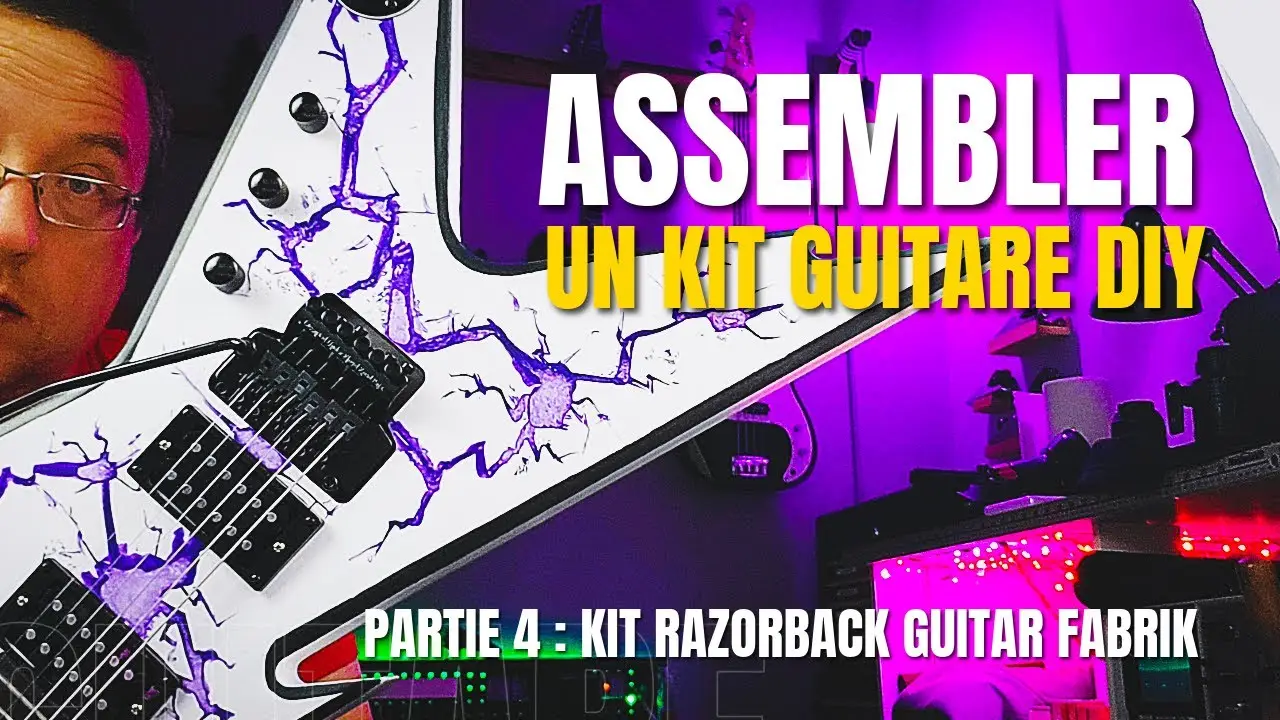
Remember the Razorback guitar kit I unboxed, fixed, and finished a while back? This kit was kindly given to me by Guitar Fabrik without any constraints, except to make videos to my liking.
After a drying period for the finishing touches, it's time for assembly and the final test! Be warned, this won't be a 5-minute tutorial where everything is wonderful. I'm going to show you the real experience: the real problems, the questions, and the tricks you need to adapt when assembling a guitar kit in real life. The end result was worth it, but the road was strewn with pitfalls!
A big thank you to Guitar Fabrik!
A quick aside: The Guitar Fabrik generously sent me this kit, without any compensation. I'd like to take this opportunity to thank them for their initiative, as it allows us to present unique content to you. As usual, my opinion will remain completely honest, whether for the good or the bad. Let's unpack it right away!


1. Bolting the neck: Precision Required
All the parts are ready, starting with the handle. Thanks to the thickness of the finish, the "fit" has become almost perfect, tighter than when unpacking.

Holes to be pre-drilled
The special feature of this kit is that the handle is not pre-drilled. It was imperative to pre-drill the body and neck to avoid putting unnecessary stress on the wood when screwing, which could create a hump and ruin the fret leveling.

- Choice of drill bit: The correct dimension is that of the screw minus the threads, almost the size of the screw shank.
- Drilling depth: I marked the drill bit with tape to make sure the hole wasn't under no circumstances deeper than the screw inserted into the fixing plate.
- Lubrication: I then took care to lubricate the screws with a little soap. Lubricated screws are much easier to insert and protect the wood.
- Tightening: The screws were tightened by hand fully tightened. The tightening was solid, but retightening might be necessary after a few hours or a day.


2. Installing the Headstock and Tremolo
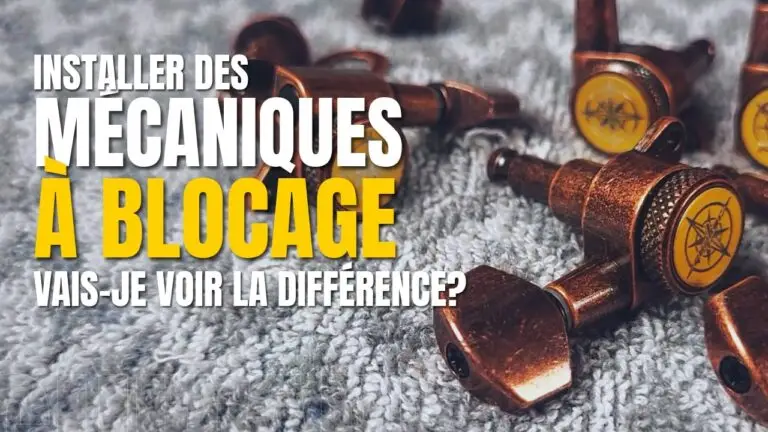
The installation of the tuning keys (mechanical) also required pre-drilling of the mounting holes. To align them perfectly:
I used a 10 mm socket to tighten the nuts, then I aligned the keys using a straight piece before drilling and screwing in the small fixing screws.
I inserted the keys and nuts just by hand.


Floyd Rose Anchors
For the Floyd Rose, we installed the two tremolo anchors. I was surprised how easily they were inserted by hand, but to make sure they were fully seated, I had to press them firmly into place (a light tap was ideal).
Finally, I cut a small piece of insulation (like that from an air conditioner) to glue to the bottom of the Floyd Rose cavity. This will prevent the tremolo from going "clang clang" and hitting the wood if you pull the bar.

3. Electronics and the Chaos of Quick Connect ⚠️
The guitar having been covered with homemade conductive paint in a previous video The messiest step was the wiring.
Grounding of Cavities
I used the smaller screws that I had to fix a wire single-conductor (single copper) at the bottom of each cavity. The wire, with a good length of insulation removed, was wrapped around the screws to ensure solid electrical contact with the conductive paint. This wire will connect the body insulation to circuit ground.


The Battle with the Connectors
The harness was already fully assembled with Quick Connects. I deduced the location of the microphones by observing the length of the cables:
- The thread YELLOW (much longer) is supposed to be the neck pickup.
- The thread red (shorter) would be the bridge microphone.
Installation became a nightmare because of the hole from the microphone cavity to the controls:
- The problem : THE three large Quick Connects never passed through the small, pathetic hole. I wasted a lot of time trying to get them through, doubting the usefulness of the Quick Connect in this setup.
- The Result: By forcing, the graphite dust conductive paint has spread all over the white finish, a disaster which required intense cleaning.
After long minutes of patience, I finally managed to get the connectors through. I also shielded the back of the control board with conductive tape to close the Faraday cage.


Installing the Potentiometers and Selector
The potentiometers were installed in the following order:
- Tone: The one that carries the capacitor (the green thing).
- Sleeve Volume: The one connected to the cable orange (which must receive the connector YELLOW).
- Bridge Volume: The one that remains. The tightening of the nuts was carried out using a 10 mm socket.
I noticed that the microphone frames were at an angle, which is questionable since the neck is probably parallel to the body.
Finally, I welded the cavity mass on the back of a potentiometer (the single ground point).
4. Checking and First Strings
After a good cleaning (using a microabrasive magic eraser on the well-cured varnish), we proceeded to the final check.
Testing Electronics with a Multimeter
- Material : Multimeter, plugged in guitar cable and a metal object.
- Resistance : The test confirmed consistent resistance values for powerful microphones (approx. 11 kΩ for each microphone).
- Functionality : By tapping the pickups with the metal object, the resistance value of the multimeter reacted, proving that each pickup and its volume/tone control were working properly.
- Grounding: Continuity between circuit ground, shielded cavities and tremolo claw was confirmed, ensuring good interference suppression.
Installation of Strings and Floyd Rose
Finally, I installed the tremolo claw (spring anchor) and connected the ground wire to it. I then positioned the Floyd Rose.

I installed the Floyd Rose pivots at about the same level. I mounted the tremolo, I used quality strings 10-52 (rather than the kit strings) and I started balancing the tension between the strings and the springs. My goal is not to play with the height of the pivot points while the strings are under tension so as not to damage them.


Next Steps
Assembly is complete! All that's left is to balance the tremolo, adjust the neck curvature and action, and then it's time for the final test. See you soon for more!