Here is a clear and structured summary of your video on finishing a flamed maple guitar kit. This article highlights staining techniques to achieve a "Private Stock" look without breaking the bank.
Enhancing Curly Maple: The Guide to a "Boutique" Finish on a DIY Kit 🎸✨
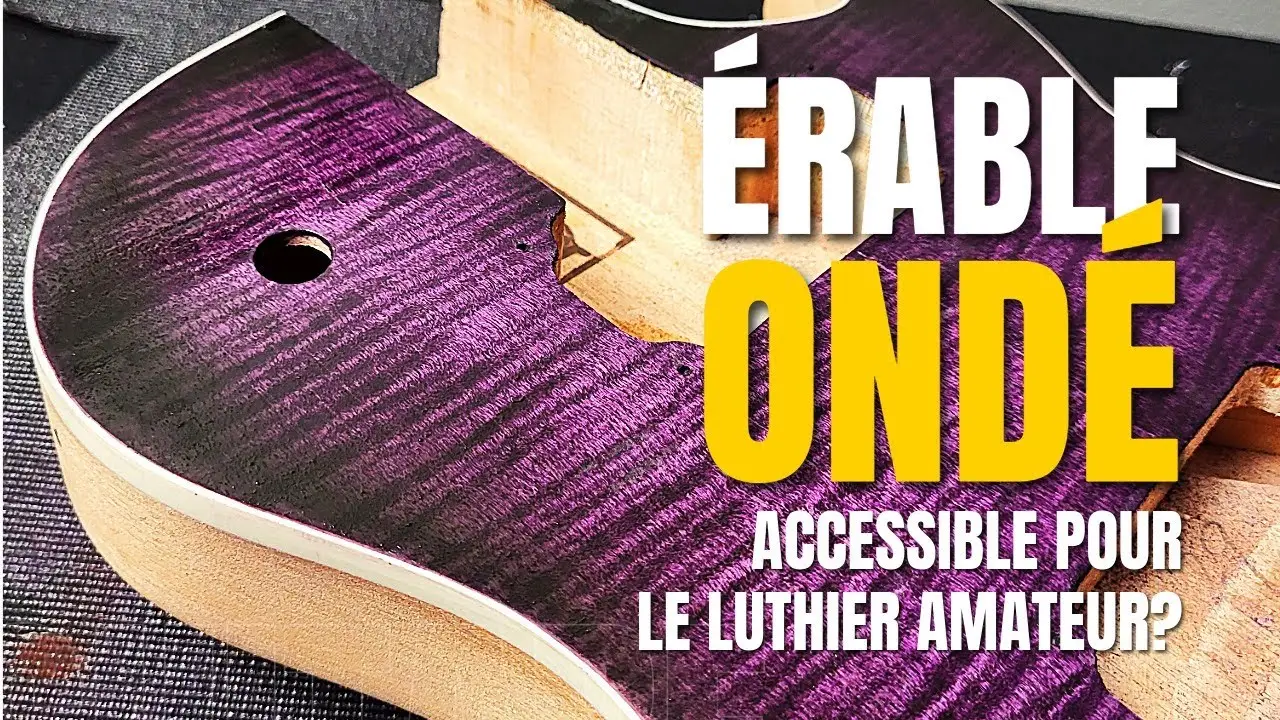
It's often believed that deep-grained exotic woods are reserved for $5,000 guitars. In reality, with an affordable kit and the right staining techniques, you can achieve professional results in your living room. Here's how to transform a kit Leo James with a flamed maple veneer (flamed maple).
1. The challenge: Working with a "paper-like" veneer«
The unique feature of these kits is that the maple veneer is extremely thin. We're talking about a thickness close to that of a sheet of paper.
- The risk: Sand through the veneer and reach the structural wood (often less aesthetic).
- The preparation: Unlike solid wood, you don't "raise the grain" with water before sanding. The wood is already very smooth. You simply dampen the surface just before staining to limit immediate absorption and give yourself more time to work on the color.
2. The multi-layer dyeing technique
The "tiger" effect comes from the uneven orientation of the wood fibers, which absorb the dye differently.
The first layer (Contrast)
- Humidification: Apply distilled water to the entire top.
- Application : Use a water-based dye (type Rit dye) violet diluted 50/50.
- Light sandblasting: Once dry, very gently sand with 320 grit sandpaper mounted on a foam pad to follow the curves. The aim is to remove the color from the hard parts of the grain while leaving it in the "hollows" of the waves.
The depth of color
For the second and third coats, switch to a dye. pure (100 %). Work quickly from the center outwards to avoid overlap marks (overlap).
3. Save the day with a black "Burst"
It often happens that glue residue on the edges prevents the stain from penetrating, or that the veneer is already damaged. The solution? A Burst.
- The Black Man: Apply an opaque black dye all around the guitar.
- The Transition: While the black is still wet (or by reactivating it with purple), pull the color towards the center with your cloth. This creates an elegant gradient that hides edge imperfections while highlighting the central purple.
4. Luthier's finishing touches: Scraping the rebate
For a high-end look, the net (bindingThe plastic part must remain perfectly white. The dye will inevitably bleed onto it.
- The method: Use an Exacto blade or a razor blade.
- The gesture: Scrape the plastic at a constant angle to remove the thin layer of dried dye until you reach pure white. It's a patient job that requires a steady hand.
5. Protection and Safety: Polyurethane Varnish
Once the stain is dry, it looks dull. Applying varnish will instantly restore the contrast and depth of the wood.
- Product : Oil-based polyurethane, applied with a pad (lint-free cloth).
- Application : Work from the center outwards in quick strokes. Avoid retracing your steps too often to prevent bubbles.
⚠️ SECURITY ALERT: FIRE RISK Rags impregnated with oil-based products (varnish, linseed oil, etc.) can to spontaneously combust by thermal reaction.
- NEVER Put them in a ball in the bin when they are damp.
- ALWAYS Lay them flat to dry on a non-combustible surface until they are hard before discarding them.
The final word
With a little motivation and patience, anyone can transform a raw piece of wood into a beautiful instrument. Water-based stain is ideal for beginners: it's odorless, takes a long time to work with, and is forgiving of mistakes.